
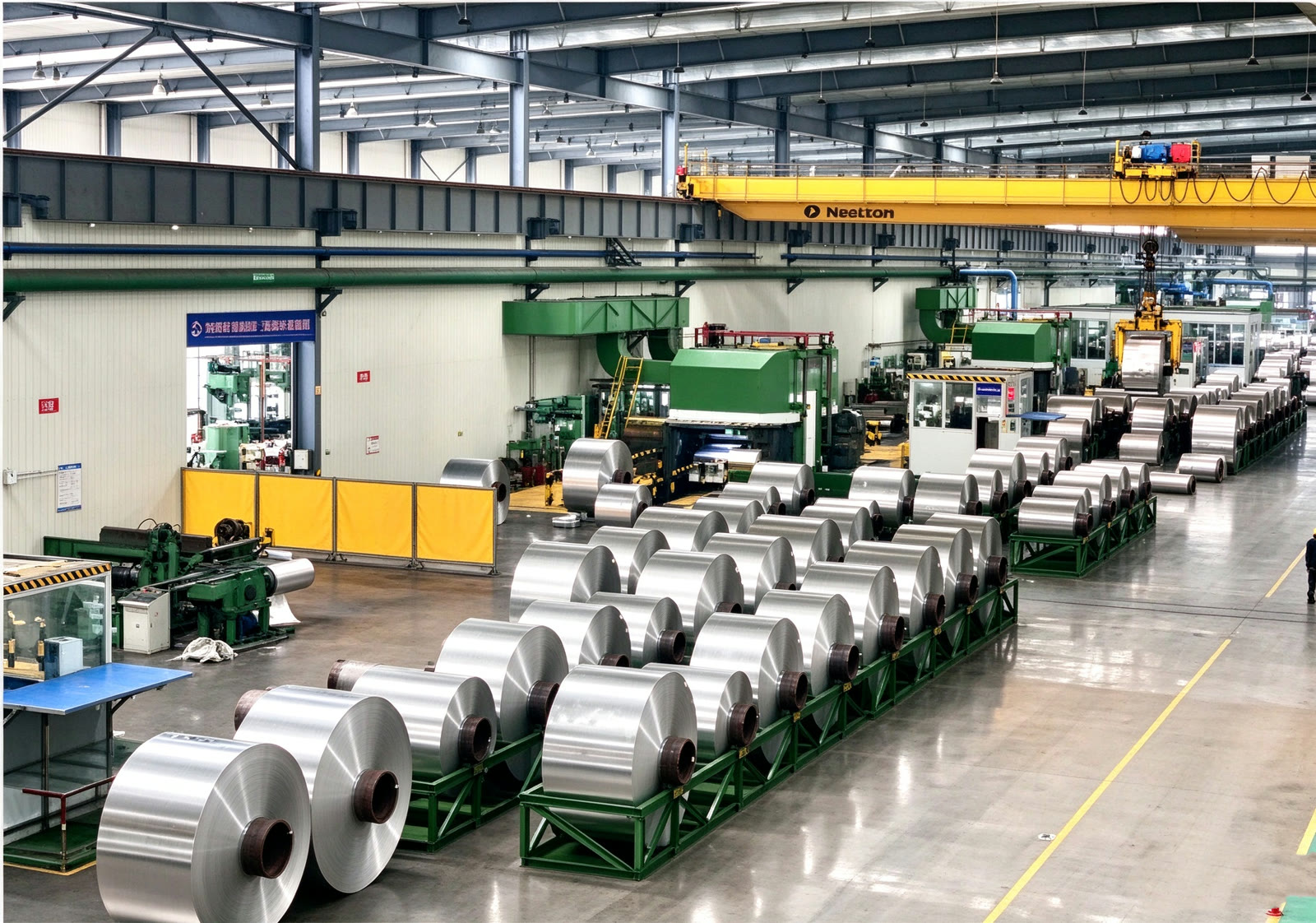
Temper is the part of a foil specification that decides whether a gauge will form cleanly or crack on the line. This guide explains what O temper and H temper actually mean in metallurgical terms, how common H tempers such as H14, H16, H18 and H32 change strength and ductility, and how purchasing and process engineers can write alloy, temper, thickness and width into a single unambiguous enquiry.
Two suppliers can quote the same alloy, the same gauge and the same width, and still deliver foil that behaves completely differently on the converting line. The variable that usually explains the gap is temper. Temper describes the metallurgical condition of the strip after rolling and any subsequent heat treatment, and it governs yield strength, elongation and springback far more than thickness alone does. For a lidding application, the difference between clean forming and tearing at the corner often comes down to one temper designation. This article sets out what the designations mean and how to specify them without ambiguity.
What O temper means
O temper, sometimes written as soft temper or fully annealed, is the condition in which the metal has been recrystallised and left with the lowest strength the alloy can practically reach. Cold rolling work-hardens aluminium, and annealing reverses most of that hardening by allowing new grains to grow and dislocations to be consumed. The result is a foil with high elongation, low yield strength and very little springback.
In practice O temper is the default choice where the foil has to deform rather than resist. Deep-drawn containers, wrap-around lidding, and foil that must conform to an uneven rim all rely on that ductility. The trade-off is handling: soft foil is easier to crease, easier to mark, and less tolerant of poor tension control during unwinding. It is also less suitable where the finished part needs to stay flat and stiff under load.

What H temper adds
H temper denotes a strain-hardened condition. Instead of annealing the work out of the metal, the mill controls how much cold reduction remains in the finished gauge, and in some cases applies a partial anneal or stabilising treatment afterwards. Strength rises and elongation falls as the amount of retained work increases, so the H series is essentially a ladder of strength levels rather than a single material.
The suffixes matter because they encode both the degree of hardening and the treatment history. Common designations on foil enquiries include:
- H14 — quarter hard. A moderate strength increase with useful remaining ductility, often used where the part needs to hold shape but still be formed.
- H16 — three-quarter hard, sitting between H14 and H18; chosen when H14 is too soft for the required stiffness but full hard would risk cracking.
- H18 — full hard. Maximum strength from cold reduction with minimal elongation; suited to flat, non-forming uses such as fin stock or rigid containers that are shaped by other means.
- H32 — strain hardened and stabilised. The stabilising treatment leaves the mechanical properties more predictable over time and at elevated service temperatures, which matters for parts that must not drift in strength during storage or in a warm filling line.
Two practical consequences follow. First, a harder temper is not automatically better; it is only better if the forming operation can accommodate the reduced elongation. Second, the same nominal temper from two mills can differ at the edges of the tolerance band, which is why mechanical property ranges belong in the purchase specification rather than being assumed.
How to write a foil specification
A useful specification is a single sentence or table that leaves nothing for the supplier to interpret. Work through the following in order, because each choice constrains the next.
- Alloy first. Alloy sets the baseline strength, corrosion behaviour and formability. State the designation explicitly, including whether a pure or alloyed grade is required, rather than describing it as “standard foil”.
- Temper second. Name the exact designation, for example O, H14 or H32, and add the mechanical property range you are willing to accept for tensile strength and elongation. If the application is a conversion you already run, quote the range that has worked rather than only the temper code.
- Thickness with a tolerance. Give the nominal gauge and the permitted deviation, and say which measuring method applies. For thin gauges a small absolute deviation is a large percentage change, so tolerances should be agreed rather than inherited from a catalogue.
- Width, edge condition and coil format. Specify width and tolerance, slit edge versus trimmed edge, core diameter, maximum coil mass and whether joins are acceptable. These details cause more line stoppages than temper does, yet they are the ones most often left out of an enquiry.
Adding the end use in one line, such as semi-rigid containers, pharma blister lidding or flexible packaging laminate, helps the mill sanity-check the combination. It is not a substitute for the four items above, but it catches mismatches early.

A simple checklist before ordering
Before releasing a purchase order, confirm that the following are written down and agreed, not merely understood:
- Alloy designation and the applicable standard or internal grade reference.
- Temper code plus tensile strength and elongation acceptance ranges.
- Nominal thickness, thickness tolerance and the measurement method.
- Width, edge type, core size, coil mass limit and join policy.
- Surface condition and any wettability, lacquer or printing requirement.
- Packaging, labelling and the coil identification data you need at goods-in.
Specifying temper properly costs one extra line in an enquiry. Leaving it implicit costs a trial run, a rejected coil, or a forming line that will not settle. Treat alloy, temper, thickness and width as a single set of decisions and both the quotation and the incoming inspection become far easier to manage.